Connect with us
Project Manager: Who They Are, What They Do, and Why It Matters
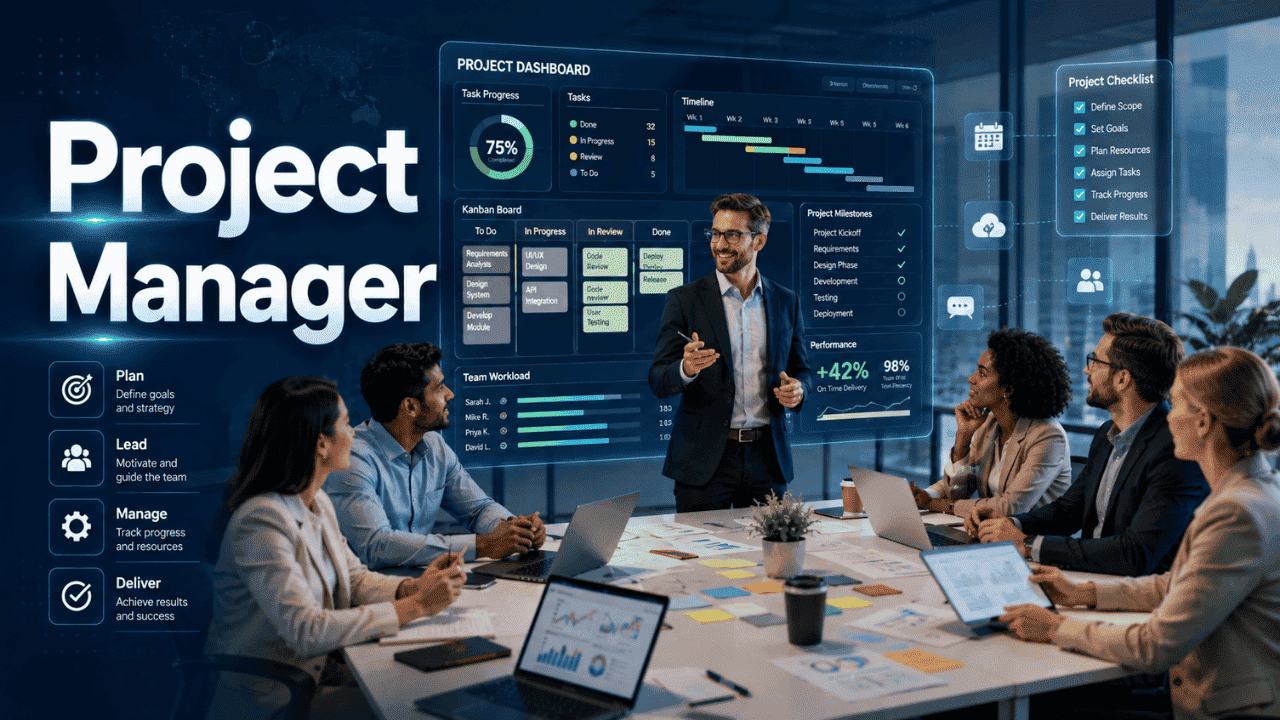
A Project Manager is the professional responsible for planning, coordinating, and delivering a project on time, within budget, and according to the agreed scope. They oversee people, processes, timelines, and resources to ensure projects achieve their intended goals while minimizing risks and keeping stakeholders informed.
Every successful project needs someone to connect strategy with execution, and that's exactly where a project manager comes in. Whether it's building software, constructing a commercial building, launching a marketing campaign, or implementing new business systems, project managers ensure every moving part works together efficiently. Their role extends far beyond scheduling meetings or tracking deadlines, they solve problems, manage changing priorities, balance competing expectations, and keep projects moving even when unexpected challenges arise. As organizations increasingly rely on structured project delivery, skilled project managers have become indispensable across industries, making it one of today's most valuable and transferable careers.
What Is a Project Manager?
A project manager is the central coordination point for a project. Not the person doing all the work. The person making sure the right work is happening, by the right people, in the right order, without the whole thing quietly unraveling.
Project management as a formal discipline has been around since long before software teams discovered Agile. NASA used structured PM frameworks in the 1960s. Construction and engineering built entire credentialing bodies around it decades earlier. What's changed is how many industries now need it.
At the core of the role sits what's called the triple constraint: scope, time, and cost. You can usually control two of them well. Rarely all three at once. Managing that tension, and being honest with stakeholders about it, is a lot of what project management actually is.
Project Manager vs. Program Manager vs. Product Manager
These three titles get confused constantly and they shouldn't. A project manager runs one defined project with a clear start and end. A program manager oversees a group of related projects serving a broader business goal. A product manager owns the long-term vision for a product and isn't constrained by a single project scope. One is thinking about what to build. Another is running the portfolio of work. The project manager is the one asking why the current timeline isn't realistic.
What Does a Project Manager Actually Do?
I've watched people move into project management thinking it's mostly organization. It is, partly. But a large chunk of the job is getting people to do things they've already agreed to do. That gap between agreed and done is where most project managers spend their days.
Planning and Scope Definition
Before work starts, the PM defines what the project delivers, what it doesn't, who owns what, and when things are due. Weak scope definitions early on create scope creep later. That's when the project quietly expands past its original boundaries until nobody can explain why it's taking this long or costing this much.
Budget and Risk Management
Project managers own the budget. They forecast costs, track spending, and flag overruns before they become irreversible. Risk management sits alongside this, identifying what could go wrong, building contingencies, and knowing which risks need escalation versus which ones can wait. According to the Bureau of Labor Statistics, financial oversight is consistently ranked among the most critical PM competencies by employers.
Stakeholder Communication
Someone has to translate between the delivery team and the people funding the project. Between technical complexity and business expectations. Between what was promised and what's actually possible given how the last two sprints went. Maintaining clear communication strategies in team projects isn't optional, it's the structure that keeps a project from drifting.
Team Coordination
Project managers assign tasks, track progress, and remove blockers. They work with people who don't report to them directly, which makes the influence side of this job genuinely difficult. Authority without a reporting line requires a different skill set than just telling people what to do.
Types of Project Managers Across Industries
Project management isn't one job that looks the same everywhere. The skills transfer. The environment, the stakeholders, and the definition of "done" change significantly.
Technical Project Manager — Works in engineering or software. Doesn't need to write code but needs enough technical fluency to have real conversations about why an estimate keeps expanding.
IT Project Manager — Manages infrastructure and technology implementation projects. Often coordinates between internal teams and external vendors simultaneously, which is its own challenge.
Construction Project Manager — Oversees building projects from planning through handover. Manages contractors, permits, safety compliance, and budgets across timelines that can stretch years. Construction project manager salary tends to run higher than many PM tracks because of the scale and liability.
Agile Project Manager — Works within Agile or Scrum frameworks. Focused on removing blockers and keeping sprints moving rather than producing heavy documentation. The Agile and Scrum frameworks aren't interchangeable, though teams use them that way.
Remote Project Manager — Honestly a different category now. Managing distributed teams across time zones without the ability to walk over to someone's desk changes everything about how you build accountability and visibility into a project.
Senior Project Manager — Larger budgets, more stakeholders, higher organizational stakes. The move from PM to Senior PM is about track record, not just time in the role.
Skills Every Project Manager Needs
The skill split is clean: hard skills get you hired, soft skills determine whether you last.
Hard Skills
Schedule and timeline management. Budget forecasting and variance tracking. Scope definition and change control. Risk identification. Status reporting. Methodology knowledge across Waterfall, Agile, Scrum, and PRINCE2. Knowing how to read a Gantt chart and build one that actually accounts for dependencies correctly is more rare than it should be.
Soft Skills
Leadership without authority. Most PMs don't have direct management power over the people doing the work. Getting things done in that environment requires credibility and relationship capital built over time. Applying effective team management strategies is something that develops through experience, not a certification exam.
Communication, negotiation, and adaptability round it out. Projects don't go the way you planned. The people who do well here are the ones who don't spend much energy being surprised by that.
Tools
Most teams land somewhere in this stack: Asana or Monday.com for task tracking, Jira for software development, Smartsheet or MS Project for complex timelines, and a team messaging platform for day-to-day communication. Understanding the best project management tools matters, but tool adoption matters more. The most sophisticated software in the world doesn't help a team that updates their boards once a week when they remember.
How Much Does a Project Manager Earn?
Salary varies significantly by industry, experience level, location, and whether you hold a PMP certification. The numbers spread widely enough that "project manager salary" searches return figures that don't always feel like they're describing the same role.
U.S. Salary Ranges
The Bureau of Labor Statistics puts the median annual salary for project management specialists at around $95,000.
Entry-level project manager: $55,000 to $70,000. Mid-level with four to eight years of experience: $80,000 to $110,000. Senior project manager salary with PMP and strong delivery track record: $120,000 to $160,000 and above in competitive markets.
Senior project manager salary in New York frequently exceeds $150,000 once total compensation is factored in. Remote roles have opened access to those higher-paying markets for PMs outside major metros, which has genuinely changed the calculus for a lot of people.
Salary by Industry
IT and software PMs tend to earn at the higher end. Construction project manager salary varies sharply by geography and project scale. Healthcare project management has grown as a category and pays well for experienced PMs with relevant domain knowledge.
How to Become a Project Manager
The path is more flexible than people expect. There's no single required degree, no mandatory starting point. Most working project managers came through adjacent roles rather than a straight line from school to PM title.
Step 1 — Build Adjacent Experience
Coordinator roles, administrative positions, team lead responsibilities, account management. Any role that involves tracking work, communicating across teams, and keeping track of who owns what is relevant experience for entry level project manager jobs. That's what employers are actually looking for at the early stages.
Step 2 — Learn the Methodologies
Waterfall, Agile, Scrum, Kanban, PRINCE2. You don't need to be certified in all of them. You do need to understand what each one is designed to solve. Most real projects use elements of multiple frameworks and the PM is expected to know why.
Step 3 — Get Certified
PMP is the gold standard. CAPM is the better starting point if you're earlier in your career. Google's project management certificate is accessible and credible for people switching from other fields. More detail on each in the next section.
Can You Become a Project Manager Without a Degree?
Yes. The certification path, particularly CAPM followed by PMP, creates a credible record that many employers take seriously without a four-year degree. The harder part is the first role without adjacent professional experience, which is where courses, freelance coordination work, and volunteer project management can help.
Project Manager Certifications
PMP (Project Management Professional)
The PMP certification from PMI is the most recognized PM credential globally. It requires 36 months of project leadership experience and 35 hours of PM education before you can sit for the exam. Pass rates hover around 60%. PMI's own research puts the salary premium for PMP holders at roughly 16% above non-certified counterparts.
CAPM (Certified Associate in Project Management)
CAPM is PMI's entry-level credential. No experience required. 23 hours of PM education needed. Designed for people new to the field or in support roles. Solid stepping stone toward PMP.
PRINCE2
PRINCE2 is widely used in UK, European, and government environments. A structured methodology as much as a credential. More valuable if you're targeting roles in those markets than in US-based tech environments.
Agile and Scrum Certifications
CSM (Certified Scrum Master) and PMI-ACP are the most commonly requested in software and product environments. If your target roles are in tech or digital teams, these often carry more practical weight than PMP.
| Certification | Best For | Experience Required | Difficulty |
| PMP | Mid to senior professionals | 36–60 months | High |
| CAPM | Entry-level / students | None | Moderate |
| PRINCE2 | UK/EU market roles | None | Moderate |
| CSM | Agile/tech teams | None | Low-Moderate |
| Google PM Certificate | Career changers | None | Low |
Project Manager Career Path
The ladder looks clean from a distance. Junior PM to PM to Senior PM to Program Manager to Director of PM or VP of Operations. What it doesn't show is that each step requires different things and a lot of people plateau mid-career by continuing to do what made them good at the previous level.
Understanding how leader standard work evolves at each stage, from hands-on execution at the junior level to organizational process ownership at the director level, is what separates the people who keep moving from the ones who don't.
Conclusion
Project management looks like coordination from the outside. From the inside it's continuous negotiation, between what was promised, what's realistic, and what the team can actually sustain without burning out.
Most projects don't fail because the people involved weren't capable. They fail because nobody was holding all the threads together. The project manager holds the threads. Staying organized as a project manager under that kind of load is a skill in itself, one that people underestimate until they're doing it.
The role is demanding. It's also genuinely transferable across industries and career stages in a way that not many roles are. Whether you're considering it as a career path or trying to understand the role better to support your team, the fundamentals don't change much. Someone needs to own the outcome. That's the job.
FAQs
1. What is the main role of a project manager?
A project manager is responsible for planning, organizing, executing, and successfully delivering a project while ensuring it stays within the approved scope, budget, and timeline. They coordinate teams, manage resources, identify and reduce risks, communicate with stakeholders, and monitor project progress from beginning to completion. Their primary objective is to ensure the project achieves its intended business goals while resolving issues quickly and keeping everyone aligned throughout the project lifecycle.
2. How does Troop Messenger help project managers?
Troop Messenger helps project managers improve team communication, coordinate tasks, and keep project discussions organized in one secure platform. Features such as direct messaging, group chats, file sharing, audio and video calls, screen sharing, and searchable conversation history make it easier to collaborate across departments and remote teams. By reducing communication gaps and enabling faster decision-making, Troop Messenger supports smoother project execution and helps teams stay aligned throughout the project lifecycle.
3. What qualifications do you need to become a project manager?
There is no single qualification required to become a project manager. Many professionals start with a bachelor's degree in business, engineering, IT, or management, while others transition from related roles through practical experience. Certifications such as CAPM, PMP, PRINCE2, or Agile credentials significantly improve career prospects. Employers generally value leadership, communication, organization, and problem-solving abilities just as much as formal education or certifications.
4. Is project management a good career choice?
Project management is considered an excellent career because it offers strong salary potential, high demand across industries, and opportunities for career advancement. Organizations of every size need professionals who can successfully deliver projects and manage cross-functional teams. Since project management skills are transferable across technology, healthcare, finance, construction, manufacturing, and marketing, professionals often enjoy diverse career options, long-term stability, and continuous opportunities for growth.
5. What communication tools do project managers commonly use?
Project managers rely on communication and collaboration tools to keep teams connected and projects on track. Alongside project management platforms like Asana, Jira, or Microsoft Project, team communication solutions such as Troop Messenger provide instant messaging, video conferencing, file sharing, and secure collaboration in a centralized workspace. Choosing the right combination of project management and communication tools improves visibility, reduces delays, and helps distributed teams collaborate more efficiently from project kickoff to completion.
6. Can you become a project manager without experience?
Yes, becoming a project manager without direct experience is possible by starting in related roles such as project coordinator, operations assistant, administrative coordinator, or team lead. Gaining experience in planning, scheduling, communication, and task management provides a solid foundation. Entry-level certifications like CAPM or Google's Project Management Certificate, combined with volunteer projects or freelance coordination work, can also help demonstrate your capabilities to potential employers.
7. What skills are most important for a project manager?
Successful project managers combine technical knowledge with strong interpersonal skills. Essential hard skills include project planning, budgeting, scheduling, risk management, and familiarity with methodologies like Agile or Waterfall. Equally important are soft skills such as leadership, communication, negotiation, adaptability, conflict resolution, and decision-making. Since project managers often lead teams without direct authority, building trust, influencing stakeholders, and solving problems effectively are critical to long-term success.