Connect with us
Top Mobile App Development Companies
A mobile app development company is a technology partner that designs, develops, tests, and maintains mobile applications for Android, iOS, or both. These companies help businesses transform ideas into secure, user-friendly, and high-performing mobile apps that support growth, improve customer engagement, and streamline operations.
Choosing the right mobile app development company is one of the most consequential decisions a business will make on its digital journey. A great app can open new revenue streams, deepen customer loyalty, and give a brand a genuine competitive edge. A poorly executed one, on the other hand, can drain budgets, delay launches, and damage trust with users who abandon a buggy or clunky product within minutes.
With thousands of agencies claiming to be the "best" partner for your project, it's easy to feel overwhelmed. This guide cuts through the noise by explaining what a mobile app development company does, showcasing some of the industry's leading firms, and sharing a practical framework, including a pre-approach checklist, to help you choose the right development partner with confidence.
What Does a Mobile App Development Company Do?
At its core, a mobile app development company designs, builds, tests, and maintains applications for smartphones and tablets. But the scope of mobile app development services today goes well beyond writing code. Most established firms manage the entire product lifecycle, from initial strategy and UX research to development, quality assurance, app store deployment, and ongoing support.
Depending on the project, a company might specialize in native development (building separately for iOS and Android using Swift or Kotlin) or cross-platform frameworks like Flutter and React Native, which allow a single codebase to run on both operating systems. Many mobile app developers also offer complementary services such as backend engineering, cloud infrastructure, UI/UX design, and post-launch analytics, all of which directly affect how well an app performs once it's in users' hands.
Understanding this scope matters because it shapes the conversation you'll need to have with any potential partner. Before you even start comparing vendors, it helps to get a sense of what a mobile-first strategy looks like for your specific business, this guide on building mobile apps that actually support business growth is a useful starting point.
List of Top Mobile App Development Companies
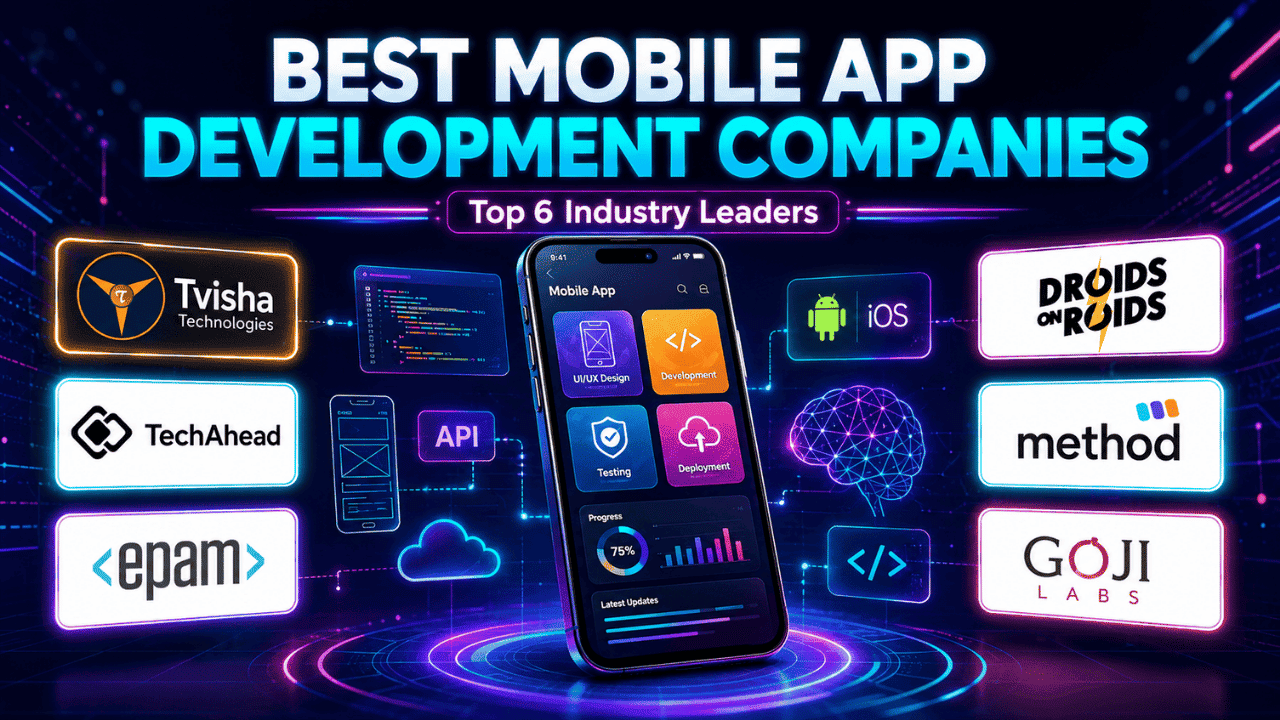
There's no shortage of directories ranking "top" agencies, but most are cluttered with hundreds of entries sorted by review count rather than actual delivery quality. Below is a curated shortlist, companies with verifiable track records, real portfolio work, and consistent recognition across the industry.
1. Tvisha Technologies (India)
Tvisha Technologies has spent close to two decades helping startups and enterprises turn ideas into functioning, scalable mobile products. The team works across iOS, Android, and cross-platform frameworks including Flutter and React Native, with deep experience in healthcare, fintech, logistics, and e-commerce app development. What sets Tvisha apart is its full-cycle approach, strategy, design, engineering, QA, and long-term maintenance are handled under one roof, which removes the friction that often occurs when design and development are outsourced to separate vendors. Businesses evaluating custom mobile app development company options often find that a single accountable partner, rather than a fragmented vendor stack, significantly reduces project risk. You can explore more of Tvisha's engineering philosophy in this deep dive on modern software development practices.
2. TechAhead (USA)
TechAhead has been active in the mobile space for over 15 years and has built a reputation for AI-first app development. The company has worked with Fortune 500 brands and holds AWS Advanced Services Partner and Microsoft Azure Gold Partner status. TechAhead's focus on agentic AI, LLM-powered copilots, and conversational experiences makes it a strong fit for businesses looking to embed intelligent features directly into their apps. More details on their work are available at techaheadcorp.com.
3. EPAM Systems (Global)
EPAM Systems is a global engineering firm best known for large-scale digital transformation work. While the company is often associated with enterprise software, its mobile division serves organizations that need secure, cloud-integrated applications connected to CRMs, ERPs, and internal enterprise systems. EPAM is typically the right fit for large corporations that prioritize governance, scalability, and long-term platform integration over rapid MVP delivery. Learn more at epam.com.
4. Droids On Roids (Poland)
Droids On Roids, now part of the Apadmi network, is a Wrocław-based mobile and web development company founded in 2011. The firm covers the full product lifecycle, strategy, UX research, development, and post-launch support, and has built a strong reputation on Clutch, where it holds consistently high ratings across dozens of verified reviews. Their recognition as a top app development company in Europe reflects a stable, repeatable delivery model rather than one-off success. Visit thedroidsonroids.com for their portfolio.
5. Method (USA)
Method, the strategic design arm of GlobalLogic (a Hitachi Group company), blends experience design with enterprise-scale engineering. Founded in 1999, Method has worked with global brands to build digital products that combine strong visual design with technical depth. For businesses that need both compelling design and robust engineering, without choosing one over the other, Method is a strong candidate. More information is available at method.com.
6. Goji Labs (USA)
Goji Labs has earned positive feedback across industries including healthcare, education, non-profit, and automotive sectors. Clients consistently praise their UX/UI expertise and their ability to translate complex ideas into user-friendly mobile and web products. Goji Labs is a solid option for businesses that want design quality to be treated as a first-class priority throughout development, not an afterthought. Explore their work at gojilabs.com.
How to Choose the Best Mobile App Development Company
Once you've shortlisted a few names, the real evaluation begins. Choosing the best mobile app development company isn't about picking the biggest name — it's about finding the closest match to your specific goals, budget, and technical needs.
Check portfolio depth, not just polish.
Ask to see real, live apps on the App Store or Google Play, not just Figma mockups or case study screenshots. A polished presentation doesn't always translate to a stable, well-performing shipped product.
Match industry experience to your vertical.
A team that has built consumer social apps may not automatically understand the compliance demands of a HIPAA-bound healthcare platform or a PCI-DSS-regulated fintech app. Ask for case studies specific to your industry.
Evaluate tech stack fit.
Native development (Swift for iOS, Kotlin for Android) still makes sense for performance-critical or platform-API-heavy apps, but cross-platform frameworks like Flutter and React Native now cover the majority of new mobile projects. A good android app development company or ios app development company should be able to explain why they're recommending one approach over another for your specific use case — not simply default to whatever they staff most easily.
Ask about in-house QA versus outsourced testing.
Quality assurance that happens as an afterthought, rather than throughout development, is one of the most common sources of post-launch bugs and one-star reviews.
Confirm post-launch support and SLA terms.
This is where many engagements quietly fall apart. Ask exactly what's included after launch — bug fixes, OS update compatibility, feature additions, and for how long.
Review pricing transparency.
Firms that clearly state a rate band and explain how they scope work are generally easier to work with than those that hide pricing behind multiple discovery calls.
Assess communication style and time-zone overlap.
If you're working with an offshore or nearshore team, make sure there's enough overlap in working hours for real-time collaboration during critical phases.
Look at verified third-party reviews.
Platforms like Clutch and GoodFirms provide a more reliable signal than testimonials hosted on a company's own website, since they typically involve verified client feedback.
For a broader look at vetting any kind of technical partner, not just for mobile, this guide on choosing the right software development partner covers additional due-diligence steps worth applying here too.
Checklist Before Approaching a Mobile App Development Company
Walking into vendor conversations prepared saves time on both sides and results in far more accurate quotes. Before you reach out, work through this checklist:
- Define the core problem your app solves. A one-paragraph problem statement is often more useful to a development team than a long feature list.
- Set a realistic budget range. Even a rough band helps agencies scope appropriately instead of guessing.
- Decide platform priority. Will you launch on iOS first, Android first, or both simultaneously via a cross-platform framework?
- Prepare wireframes or reference apps, even rough sketches or links to apps you admire. Visual references speed up early conversations significantly.
- List MVP must-haves versus nice-to-haves. This prevents scope creep and keeps your first release focused.
- Identify compliance needs upfront, HIPAA, GDPR, PCI-DSS, or any other regulatory requirement relevant to your industry.
- Ask about maintenance terms before signing anything. Don't wait until after launch to discover what's covered and what isn't.
- Request industry-specific case studies, not just a generic portfolio deck.
Coming prepared with these answers also makes it far easier to compare quotes apples-to-apples across multiple vendors.
Mobile App Development Process — What to Expect
Understanding the typical development process helps set realistic expectations for timelines and deliverables, regardless of which company you choose.
- Discovery and requirement gathering comes first — a good team will ask detailed questions about your users, business goals, and technical constraints before writing a single line of code.
- UI/UX design follows, typically starting with wireframes and progressing to high-fidelity prototypes that can be tested with real users before development begins.
- Development usually happens in agile sprints, with regular check-ins and incremental builds rather than one large reveal at the end.
- QA and testing should run in parallel with development, not just at the very end — catching issues early is significantly cheaper than fixing them post-launch.
- Deployment and app store submission involves navigating Apple's and Google's respective review guidelines, which can introduce delays if not planned for in advance.
- Post-launch support and maintenance covers everything from bug fixes to compatibility updates as new OS versions roll out — this phase often continues far longer than the initial build.
Cost of Hiring a Mobile App Development Company
Costs vary widely based on complexity, platform count, and where the development team is based, but general benchmarks look like this:
- MVP (Minimum Viable Product): Typically ranges from $25,000 to $60,000, covering core functionality needed to validate an idea with real users.
- Full-feature consumer app: Usually falls between $60,000 and $150,000, depending on design complexity and backend requirements.
- Enterprise-grade application: Often exceeds $150,000, particularly when compliance, integrations with existing enterprise systems, and high security standards are involved.
Beyond the base build, factor in ongoing costs like server infrastructure, third-party API fees, app store fees, and post-launch maintenance retainers — these are easy to underestimate during initial budgeting.
Industries That Rely on Mobile App Development Companies
Mobile apps have become core infrastructure across nearly every sector:
- Healthcare — Patient portals, telemedicine platforms, and appointment scheduling apps that must meet strict data privacy standards.
- Fintech — Digital banking, payment processing, and investment platforms where security and regulatory compliance are non-negotiable.
- E-commerce — Shopping apps with personalized recommendations, in-app purchases, and seamless checkout experiences.
- Logistics — Fleet tracking, delivery management, and real-time GPS-based routing applications.
- EdTech — Learning management systems and interactive course platforms designed for engagement and retention.
Each of these verticals comes with its own technical and regulatory nuances, which is why industry-specific experience matters so much when evaluating a potential development partner.
Common Mistakes to Avoid When Hiring a Mobile App Development Company
Even experienced founders and product teams fall into predictable traps during the hiring process:
Choosing based on lowest price alone. The cheapest quote often reflects fewer QA cycles, less senior talent, or hidden scope limitations that surface later as costly change requests.
Skipping reference checks. A quick call with a past client can reveal far more about communication style and reliability than any polished pitch deck.
Ignoring post-launch support terms. Apps require ongoing maintenance as operating systems update — a team with no clear support plan can leave you stranded after launch.
Not clarifying IP and code ownership upfront. Make sure your contract explicitly states that you own the final codebase and all associated intellectual property.
Underestimating maintenance costs. Many businesses budget only for the initial build and are caught off guard by the ongoing cost of keeping an app updated, secure, and compatible with new devices.
Final Thoughts
Choosing a mobile app development company is rarely just a technical decision — it's a partnership decision. The right team will ask sharp questions about your business before proposing a single feature, communicate transparently about cost and timelines, and stand behind their work well after launch day.
Whether you're evaluating Tvisha Technologies or any of the other companies mentioned in this guide, the checklist and evaluation criteria above should give you a solid foundation to make a confident, informed choice. If you'd like to discuss your specific project requirements, Tvisha's team is happy to walk through your goals and outline a realistic path forward.
FAQs
1. How much does it cost to hire a mobile app development company?
Costs typically range from $25,000 to $60,000 for a basic MVP, $60,000 to $150,000 for a full-featured consumer app, and $150,000 or more for enterprise-grade applications. The final price depends on platform count (iOS, Android, or both), design complexity, backend requirements, and any compliance needs like HIPAA or PCI-DSS. Always ask for a detailed scope breakdown rather than a single flat number, so you understand exactly what's included at each budget level.
2. What's the difference between native and cross-platform app development?
Native development uses platform-specific languages, Swift for iOS, Kotlin for Android, and delivers the best performance for complex, hardware-intensive, or platform-API-heavy apps, though it requires separate codebases. Cross-platform frameworks like Flutter and React Native let developers write one codebase for both platforms, reducing cost and development time. Today, cross-platform covers roughly 80% of new mobile projects, while native is typically reserved for apps demanding maximum speed or deep device integration.
3. How long does mobile app development take?
Timelines vary based on scope and complexity. A basic MVP focused on core functionality usually takes 8 to 12 weeks to design, build, and test. A full-featured consumer app typically takes 4 to 6 months, while enterprise-grade applications with complex integrations, compliance requirements, or multiple user roles can take 6 to 9 months or longer. Working with a mobile app development company that runs agile sprints often shortens delays through incremental delivery.
4. How do I know if a mobile app development company is legitimate?
Look for a real, live portfolio with apps available on the App Store or Google Play, not just design mockups. Check verified third-party reviews on platforms like Clutch or GoodFirms rather than relying solely on testimonials from their own website. A legitimate company will also be transparent about pricing, willing to share case studies relevant to your industry, and open to connecting you with past clients for reference calls.
5. Should I hire a local or offshore mobile app development company?
It depends on your priorities. Local teams make real-time collaboration and time-zone alignment easier, which can help during fast-moving discovery or design phases. Offshore or nearshore teams often offer significant cost efficiency without compromising quality, provided communication processes are clearly established from the start. Many businesses successfully use a hybrid model — local strategy and design paired with an offshore or nearshore development team for execution.